



Pavilion is a proactive educational network providing news, information services and resources for and about multiple personality.
Thank you Wicks
A Suggested Glossary
The fundamental sign of absence of cultural permission is the lack of words in the language of the dominant culture which would suffice to describe an experience. - Anthony Temple
This glossary is not a list of "official terms" or "politically correct terms". It is a collection, begun by the Anachronic Army system, of words that people have used in writing about their personal experience of multiplicity over a period of about ten years. None of these terms were conceived or put into general use by astraea.The glossary's purpose is to provide common terminology. Think of it as trade talk, words we can use so that we'll know what each other are talking about. These are not "politically correct" or "official" terms. This glossary is mirrored at Pavilion.
These are suggested terms only -- you are not required to use these words when speaking of your own experiences. You may have words that are better than what we have here -- if so, please send them along (pavilion at karitas dot net or use Astraea's mail form) as we are always looking to expand and improve this subject. This is a living document, not carved in stone. It is at all times subject to change.
Dark Personalities have another glossary up here.
The Fenners have another glossary here.
Age Slider - Person whose age changes, or who identifies as being different ages at different times. The range of age traversed by age sliders can have a wide variation -- they may change from children to adults, or from older teenagers to younger teenagers, etc. (Various members of the DarkPersonalities List)
Alter - In the original psychiatric view, being multiple meant the people in your group were one-dimensional, representing aspects of one person which had been split off. It meant naming the aspects of a single personality. Right after Dr. Pierre Janet presented his ideas on "dissociation", the "alters" were supposed to fit the Jungian archetypal pattern: the Child, the Stern Protector, the Harlot, the Aluminum Siding and Storm Door Salesman and so forth.
The professional literature portrayed persons in multiple groups as cardboard characters, lacking substance, etc. The more substance they did have the more it was supposed to have been drained from the "depleted host", the original person who had put almost all her (it's always "her" in these reports) energy into these imitation people. This is how the word "alter" came into use; it meant a non-person; two-dimensional masks, paper dolls that the weak pathetic host personality hid behind for protection.
Use of the term "alter" implies that one person in the group is real and the rest are not, or are less real. Even in systems where there is an original person the others came from, or where one person considers themself to be hosting the others, "alter" is taken by many systems as an insult, roughly analogous to "white only" and "separate but equal" in the segregated South.
What should you say instead, to indicate you mean members of a multiple group, rather than one-person/one-body individuals? Truddi Chase & The Troops said "self" and "selves". Or you can just say people. If you feel you have "people in your head" you can say "headmates" (bearing in mind that not all multiples feel the others are "inside", let alone "in their head"). Some groups in the late 80s called them insiders.
Being Out - The experience of being in control of the body, interacting with the world-at-large. The person who is out may or may not be co-conscious with others in the body who are near the front. (Bekaio)
Blurring - A feeling of being unsure of one's own identity when in front. Can happen when someone is new to the front, or because others in the multiple system are also very close to the front. Or because the person is new to the system and may possess a seperate sense of "self," but not of the nature of that particular self. May occur during co-consciousness. "Hi, I'm not sure who I am." Some people call this "being mushy".
Co-conscious - The state where two or more people in a multiple system or group share an awareness of what's going on, especially what's happening up front. People experiencing co-consciousness are not necessarily completely aware of each other's every thought and feeling. Some people feel co-consciousness is a slippery term, and prefer co-running and co-present as more descriptive. Co-consciousness helps with running a system smoothly, but there are plenty of multiples who have no co-consciousness and have little or no problem with activities of daily living -- they use notes and lists instead. (Dr. William MacDougall, 1926) ( Click here for MacDougall biography & articles, including one on co-consciousness) (Site temporarily off line.)
Co-present - The experience of more than one person fronting at once; more than one person experiencing the world-at-large at the same time, without necessarily being able to know what other people at the front are thinking or feeling.
Co-running - More than one person is not only present at the front, but both (or more) are actively using the body. Singlets who think this is impossible or confusing should remember that the next time they catch themselves watching television, talking on the phone and stirring soup all at the same time. Usually not more than three or four people co-run.
Core - In the old MPD model (pre-2000), all plurals begin as one person, the core, who splits off parts of herself. This is not the experience of many plurals, especially those whose systems did not originate from trauma. However, some systems really do have one or more cores from whom everyone else came -- Truddi Chase (& The Troops) described it as a kind of birth process. Also, 'core' might be a useful term for medians, to describe the central person (if any) in their system. In systems that do have a core, the core and the presenting self or selves -- the one(s) people are most likely to see -- are not necessarily the same person. The core is also called the 'birth person' or the 'original' or 'first-born child'. We've known two groups who called this the "base". (Psychiatric)
Covert switch - Many plurals do not switch obviously or overtly. The change may not be obvious even to the people in the group. Selves may simply influence feelings and actions rather than coming "out" to take full control of the body. This may be the source of sensations like hearing words coming out of your mouth that don't belong to you, seeing the world as if you are taller or shorter, having someone else's feelings and thoughts overlapping your own, and so on. This covert, behind-the-scenes action is usually hard for anyone on the outside to notice (although someone familiar with multiples, or with your group, might sense a hidden influence and say something like "Is there someone behind you right now?"). For this reason, multiples can realistically go for decades with no one, including themselves, being aware they're plural. (Psychiatric, possibly Cornelia Wilbur)
Dissociative Identity Disorder - The official multiple-personality diagnosis. Replaced multiple personality disorder at the behest of mental health academics who wanted to put an end to the theatrics of the recovered-memory movement in psychotherapy. It was once believed -- and promoted by charismatic individuals such as Cornelia Wilbur -- that multiplicity was almost always caused by severe, repeated child abuse, usually sexual, and was an extreme form of dissociation. Wilbur further complicated things by redefining dissociation as withdrawal into fantasy. DID's official definition looks no different from the old DSM-III code 300.14, as seen here. However, it is unofficially defined as the experience of a single person who's deluded into thinking he or she is many and needs therapy to cure the illusion. The older term multiple personality disorder may fit multiples who are impaired due to communication and/or organization problems, but it is inappropriate for the many multiples who have a working operating system and know how to work together in harmony. If you are not disordered, and particularly if you haven't been diagnosed with MPD or DID, it is probably unwise to refer to yourself as having MPD or DID. (Psychiatric)
Dissociation - Originally, the process by which aspects of one's own personality which are unacceptable to oneself or to society are stifled, set aside, disclaimed. Early psychiatric investigators believed this occurred because of societal or parental pressure, and that it particularly affected women because of their lower status, but men too. The idea was that these denied aspects, if they reached critical mass, could form into a second personality. William James and Carl Gustav Jung wrote about this.
Today, dissociation has been redefined as a rejection of traumatic events, a kind of willful forgetting, an elaborate pretending, and a conscious effort to believe that the events "happened to someone else". Not all abused children do this -- not all multiples do this (we never did), but that is of no consequence to mental health professionals, because if you tell them the truth about your experience, they can always say you're in denial!
Recently, dissociation is being redefined again; simple absentmindedness, or merely thinking about one thing while doing another so that one loses awareness of one's immediate surroundings. If this is correct, dissociation is a lucrative industry, what with all those copies of The New York Times being sold at train stations, and all those books on tape for people driving to work.
Some people suspect that there is no "dissociation epidemic" and that the mental health industry is pathologizing a simple fact of life. The idea that thinking about anything other than your immediate surroundings is wrong smells of mystical doctrines such as those of Gurdjieff and Ouspensky, or the "be here now" of 60s gurus such as Baba Ram Dass. In other words, useful for some people, but not to be taken as gospel, or as necessary to mental stability, by everyone. (Psychiatric)
Driver - Usually, a frontrunner. We heard from one group who use this word to describe shared skills.
DSM-IV - Stands for Diagnostic and Statistical Manual (of Mental Disorders), 4th edition. The most recent version is called DSM-IV-TR (Text Revision). Official reference guide of the American Psychological Association, used in clinical and sometimes in legal situations. Dissociative Identity Disorder is listed in this manual as diagnostic code 300.14. Some people question the validity of many DSM-IV diagnoses -- for example, it lists bad handwriting and shyness as mental disorders. Many DSM-IV diagnoses are assigned primarily for the purpose of obtaining an insurance claim -- some companies will refuse any claims for therapy if the patient does not have an official diagnosis. Thus, a client may be diagnosed with something they don't have merely so insurance will cover it while client and therapist work together to find out what is really wrong. That's one possible scenario out of many.
According to an insider, the criteria by which DSM diagnoses are established are "arbitrary, condescending, profit-driven and riddled with personal biases and political consideration." It might be a good idea to read a couple of books about how the DSM is used to pathologize normal life experiences and what's behind the words in the diagnostic criteria that have been used to label you.
The DSM-5 is now being prepared, and the doctors who are working on it -- the same ones who are paid by drug companies to diagnose mental diseases -- have been required to sign a non-disclosure agreement. That's right, the preparation of this document which affects millions of people's emotional and legal lives is being done by shadows hiding behind closed doors. Click here to read a New York Times article about the DSM-5 coverup.
They Say You're Crazy
Making Us Crazy: DSM, The Psychiatric Bible and the Creation of Mental Disorders
Earth world, world-at-large - This world, this physical or consensus reality. Used by people -- multiple, median, or singlet -- who experience other worlds or inner worlds of any kind -- to distinguish between events 'here' and events in those worlds, e.g. 'I have a dentist appointment in the earth world today". (Vicki(s), general English usage)
Empowered Multiples - Most often, it refers to multiples who do not take a victim stance and who are not overly dependent on psychotherapy to the point that they become enmeshed in the therapy culture. Any multiple system can be empowered. Empowerment is the ability to take responsibility for one's life and make conscious choices rather than simply going along with what someone else says.
Empowerment is for all multiples. It is not only for natural (non-trauma) multiples; you can be empowered and be a multiple who was born as one person and split due to child abuse. In fact, if that's your situation, empowerment is a wonderful thing for you, and is something your therapist (if any) ought to be encouraging.
Empowerment does not mean "perfectly functioning in every conceivable aspect with not the slightest trace of a problem in any area of your life and no abuse or trauma of any kind at all in your past." Empowerment does not mean rejecting therapy, or even medication, if those are helpful to the system. Empowerment is simply placing a high value on personal ability to choose, rather than becoming overly dependent on authority to define and guide your life. Even a therapist -- even a good one. Empowerment also means the right to interpret one's own system, rather than automatically believing everything therapists (or anyone else) tell you about yourselves. Empowered multiples are those whose people learn to cooperate, perhaps to communicate with each other (whether through notes or directly), to organise themselves into a responsible operating system, and see multiplicity as a positive part of their lives -- regardless of how their multiplicity originated. (Shaytar)
FMS - Abbreviation for False Memory Syndrome.
False Memory Syndrome - Term coined by Pamela Freyd, founder of the False Memory Syndrome Foundation, to describe people who have become convinced (usually, but not always, through therapy) that they remember traumatic events in their past which didn't really happen. There is no diagnostic code for "False Memory Syndrome" in the DSM-IV.
Nowadays few people doubt that it is possible to become convinced of events which never really happened -- and certainly unethical therapy exists. However, FMSF doctors and supporters generally believe that repression of memories is never possible, that multiplicity doesn't exist, and that it is always induced by bad therapy. This is based on their assumption that all multiples claim abuse histories, are in therapy, and have undergone hypnosis to recover memories of abuse. There are several sites dedicated to disproving the assertions of the FMSF.
Fictive - A person from fictional sources, who is adopted into the mindspace of another person. Psychologists refer to this as an introject but many people feel there is more to it than that.
Such a character may be a very real presence to his host, but might not step outside his own world, or interact with the earth world in any way. The idea that characters or fictive persons habitually front is a mistake. If your characters do not, you are not "doing it wrong".
When a fictional or imaginary character communicates with you and does begin interacting with the everyday world in some way -- either by making comments or suggestions, asking you to do or obtain certain things, or taking your body to act independently on his own -- he or she should be respected as a person in their own right in your reality, and you should arrange responsible communications and cooperation just as a multiple or median group would. (Online term)
Having fictive persons in the group is a form of hosting. Some people report having historical persons, or simply ordinary people from former times, in their groups as well. This was known to the early Spiritualists who called it -- you guessed it -- multiple personalities.
Flying Toaster Slang for the misconception, popularized by D. Scott Rogo, Truddi Chase (& The Troops), and certain members of the psychiatric profession, that multiples invariably have extreme psychic ability -- or that there is a known, documented connection between multiple personality and psychic experience. The term was coined by Rebekka Cowan of the Two Courts on a long-ago mailing list. Why "toasters"? Probably a combination of the old Mac screen saver and anecdotes by the Troops' therapist about the group's seeming ability to (inadvertently) fritz out electrical equipment, although toasters are never mentioned specifically. In fact, actual toast figures prominently in When Rabbit Howls, leading one to wonder how they managed to get their toaster to work, considering all the exploding lightbulbs, dead batteries, and staticky tape recorders they had to contend with.
"Flying toasters" is an idiosyncratic term used sarcastically by some multiples; it is not in general terminology. Feel free to use it, though. Recently some have been using the verb "to toaster", to affect something via psychic ability, and "toaster powers" for psychic abilities, again facetiously or sarcastically.
Whether or not psi exists objectively is not the issue; "flying toaster" satirizes the idea that multiples have more psi ability or capacity than singlets. Contrary to urban legend, there has never been any professional study done on this subject nor any articles on same published in peer-reviewed journals. Dr. Allison gave his opinion that all multiples were psychic (or rather, that he had never met a multiple who was not psychic) in an interview for D. Scott Rogo's book Infinite Boundary, a speculative book written for the general public; but that does not make it a proven fact, any more than Cornelia Wilbur's assertion that she'd "never met a multiple with an IQ below 140" means that all multiples are highly intelligent. (Courts^Rebekka)
Fragment - The word "fragmented" was made up by doctors (probably Dr. Richard Kluft -- he loves making up terminology) who mistook persons in a multiple system for fragments of a single shattered self. "Fragment" is also often used to designate a person in the group who seems to do only one thing (that is, only one thing that the doctor ever sees this person do), an "incomplete alter", or a kind of extreme form of compartmentalization of thought and action. Some plural systems do experience some of their people as fragments only; sometimes they create them deliberately; they may call them shells or shards.
Front - Or out front, or forward . The mental position or state of mind in which one occupies or runs the body, interacting with the world-at-large.. "John was working today so he was up front." Some groups call this "driving" or being "at the helm" or "running the body", while copresent people might be "passengers" or "riding shotgun". (Probably the Troops (Truddi Chase)).
Frontrunner - Usually, a person who habitually occupies the front position or is accustomed to doing so. (The Troops (Truddi Chase)) We've also heard this called being a "reflector", an "outsider" or a "driver".
Multiples often have several frontrunners who can stay up front for periods ranging from seconds to years, or a succession of frontrunners, each of whom stays at front for an extended time. Many medians have a single main frontrunner, though others in the system are capable of taking the front. (Various)
Fronting - Being at the front; act of being out, using the body. "John was out in the earth world, so he was fronting." (Shaytar)
Gateway system One in which the people live in another world or dimension and use the physical body to interact with the earth world. Not everyone from the home dimension may frontrun, they may not be interested. Some multiples who claim a very high population may be counting the population of their homeworld, whether or not those people front. It is usually considered less confusing simply to count the frontrunners. (Shaytar)
Netdancer have some observations on 'inner' worlds
More on personal worlds and gateway systems from Pagmies
Headmate - Persons who share your group space, applicable if you feel you have "people in your head", whether they actively take the front or not. (originated with the Soulbonding community but used by groups who have no fictive persons)
Host - 1. Term formerly given to the person who is at the front the most -- also called a presenting self, the one that the world-at-large thinks "you" are. Some multiples still consider it derogatory, because it originated as a psychiatric term involving the belief that all multiplicity involved a single, "real person" with a number of parasitic "alters" -- the classic or MPD setup, in which the "alters" were expected eventually to integrate with the host, becoming a single person. Sometimes the core person, if any, is also the host, but not always. More about this in the FAQ. However, the term itself is less derogatory than the misapprehension that all multiples must include or stem from a host personality. (Psychiatric)
2. (also hosting) Among some multiples, otherkin, and some who have fictive or historical persons in their group, 'host' or 'hosting' have an entirely different meaning -- either a person who has others as guests, or in the old Biblical sense of an entire collective, not any particular person (the heavenly host). If you're not sure of its usage in a plural group you encounter, ask for clarification. (Spiritualism, neopagan)
Inner World - See Other World. Some people reject the term "inner world" as inaccurate, because it implies something that is imaginary or only in one's mind rather than an alternate reality. They prefer to call it an otherworld or subjective world or one's own world, rather than an inner one. Some people really do have inner worlds, though. Inner or other worlds are not limited to multiples; many singlets report having their own worlds. We know of at least one group who referred to their subjective world as a "matrix" long before the movie came out. (General usage)
Integration - A controversial act where all the people in a multiple system merge into one. As part of the psychiatric model, integration was thought to be necessary -- a part of the ultimate 'cure' for what was thought to be a disabling mental disease. At one point virtually every multiple system in therapy was guided toward integration. But it has since been revealed that many 'successful' integrations were not permanent, including those of Shirley Mason ("Sybil"), Chris Costner-Sizemore ("Eve") and Billy Milligan. A heated issue in the community, but most seem to feel integration is a matter of personal choice and should be a unanimous decision by the system in question. (Psychiatric)
Some people in multiple systems can integrate at will, forming a third or "compound" individual. Billy Milligan was described as being able to do this. All the groups we've talked to who can do this say it is a useful skill but not something they would recommend doing unless absolutely necessary. Like Milligan, they experience the whole as being less than the sum of the parts.
Introject - Introjection occurs when a person (singlet or plural) internalizes another person (real or fictional) into his or her mental space. In classical psychology, the introject is usually a parent, whose advice for good or ill becomes integrated into the person's moral system. More broadly, many people experience introjects as a kind of muse, inspiring them to creativity or self-improvement (a psychologist would call this an "internalized imago"). (Psychiatric)
"Introject" is seen as derogatory by some, because it is a psychiatric word and seems to imply that such people of necessity are unreal. They prefer terms like walk-in, soulbond, or fictive. Having an introject does not necessarily mean you're multiple. It is an experience common to singlets and plurals. Some multiple systems report adopting people from books, films, or real life, making them part of the group and allowing them to take the front if they desire.
Losing Time, Timeloss - The experience of losing track of the passage of time. Happens to singlets, multiples and medians, for any number of reasons from simple preoccupation ("Where did the time go?") to drunkenness, drug use (prescription or otherwise), or illness.
Losing time is not a pathological symptom, despite modern psychiatry's attempt to designate it as one. Recently, there has been a movement by modern psychiatry to designate this perfectly normal phenomenon as a mental disorder. They're ignoring the fact that there is such a thing as subjective time, which cannot always be measured by a clock, in addition to objective or real-world time.
Some people in multiple or median systems experience timeloss as a result of being inside while someone else was out front. Upon returning to the front they may have no idea that time has passed in the earth world. A good communication and operating system can help keep track of what's going on, so that even if you have lost time, another group member can tell you, or you can find a record or log, so to speak, of what has happened while you were gone. (Psychiatric)
Merge - See integration. (Psychiatric)
Mid-Continuum - See Median. (Vicki(s))
Median - Being neither multiple nor singlet. Many people feel the idea of a continuum from singlethood to plurality to be inaccurate, so are seeking a term to replace mid-continuum.
"Median isn't sharing a common memory or the front having traits of its own or fronting through a body-based filter, that's just a common part of many multiple systems. Median is a fuzzy state between single and multiple, a single identity made up of multiple identities." -- lj-personasystem
Probably the main characteristic distinguishing medians from singlets and multiples is the presence of more than one person in the body, but without the independence of persons in a multiple system. Persons in a median system may be dependent upon a single individual (who may have created them at some point), and unable to exist without that central person. Some people in a hosting situation might think of themselves as median. Others describe something like Kiya's situation, or Adriel's. You might say something like "there are many of us, but we are really all Karen" or "aspects of Karen", etc. Various metaphors have been invoked by median systems to describe their experience, such as a stem with leaves, the spokes of a wheel, pages in a book, or a sun orbited by planets.
(Beware: many therapists will tell members of multiple systems that they have no independent validity but are really all aspects of the frontrunner or host, or whomever he (the therapist) believes to be such. "You're really all Karen, you know." If you do not feel that this is true for your system, be true to your experience before taking a therapist's word for it -- he is, after all, outside your system, and very probably a singlet, one who has never experienced multiplicity and doesn't know much about what it can be like.)
People often mistakenly think they must refer to themselves as median or midcontinuum because:
Here are a couple of diagrams that may help to illustrate the relationships between these experiences:
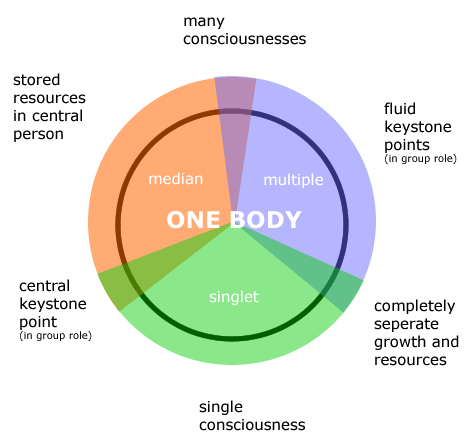
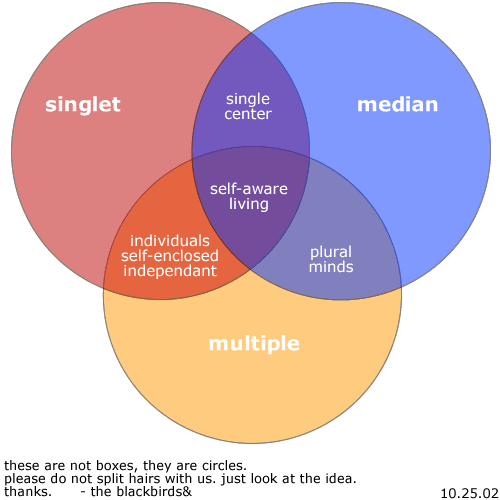
by Lucas and Malik of the Blackbirds
Note that in both diagrams they mean for the experiences described to be fluid, not static -- you might move between various states at different times of your life -- and accounts for groups who feel they are both median and multiple, or median and singlet, etc. (Blackbirds^Lucas & Malik)
Multiple, Multiplicity - Two or more independent people who use the same body; the experience of sharing the body with others. Is included in plurality, but implies more separation and independence of people than being median. May or may not be associated with losing time, hearing voices, having an other world. Some people abbreviate it as "multi", and we've also heard "multimind". ^_^
Some people refer to the persons in a multiple group or system as "multiples" ("I think I have multiples" "How many multiples do you have?"), but due to possible confusion we usually ask people to stick to "persons", "people", "group members" and so on. Most of the literature and discusions refer to a "multiple" either as the collective itself, the entire group within the shared body, or as the definition of the main front or person you first met ("Truddi Chase is a multiple.") (General usage)
Multiple Personality Disorder - Prior to the recovered-memory movement and its subsequent scandals and lawsuits, anyone who was found in therapy to be multiple supposedly had MPD. The presence of more than one person in the body is and has always been defined by the dominant culture as a pathology. The most popular example of a person with MPD is Sybil. Both MPD and DID are described as fragmentation of a single, pre-existing "whole" personality after traumatic experience.
Natural Multiples - Multiples whose system came about as a natural part of their development, not as an outcome of abuse or trauma. Some natural multiples believe there may be a neurological predisposition involved, but there simply hasn't been enough scientific study to say anything for certain. (First heard the term and the concept from a psychiatrist correspondent.)
Other World -Also known as inner worlds and alternate realities. The subjective space experienced by members of a system. People who are not up front often spend their time in a subjective world. Also called an imaginal space or the "imaginal realm". French scholar Henry Corbin talked about the imaginal as a region that exists alongside our everyday three-dimensional consciousness. His study of Sufi and Persian sacred texts suggests that there is a place in our imaginations where things are "real," in the sense that they are not being imagined by a specific person but are images that have some kind of integrity or existence on their own. Some Southeast Asian and Native American belief systems hold that what we think of as "the real world" is a reflection or shadow of another, even more real world which we cannot perceive directly, but only through such things as dreams, imagination, myths, psychedelic and/or spiritual experiences.
Other worlds are not unique to multiples; medians and singlets can have them as well (cf. singlet Austin Tappan Wright's Islandia, Edith Wharton's "secret garden" (described in her autobiography Backward Glance), or the Brontes' Angria and Gondal (the Brontes often adopted and "became" fictive or historical characters). Many people with such worlds resist calling them inner worlds or imaginary worlds, because these worlds are not make-believe or fantasy to them, but an emotional reality, an important part of their lives. People who are familiar with soulbonding refer to this realm as a soulscape, since they feel they interact with their muses or introjects there. (General usage)
Netdancer collective have a lot to say about personal worlds
More on personal worlds and gateway systems from Pagmies
Otherkin- People who feel they do not possess human souls, but are rather an animal, someone from another planet, or a supernatural spirit (like a fairy) born into a human body. A sort of changeling. Until the advent of the internet, such people were recognized and acknowledged in Western culture only by New Age and Theosophical doctrines, which referred to them as elemental spirits incarnating in human bodies, or persons on a "deva" (angelic) evolution path. One work of fiction, Zilpha Keatley Snyder's The Changeling (1974), touched on this idea and introduced it to young children without heavy explanation. Online beliefs about otherkin are largely pagan or secular in nature and in any case partake of much more free thought, unencumbered by dogma.
Many indigenous cultures believe in otherkin in some form, especially that humans can have animal spirits or be related to animals.
Some people in multiple systems may be otherkin. Often they are walk-ins. May perceive themselves as having physical traits very different from the body's.
These documents have been said to be helpful for some people -- others find them confusing, your mileage may vary:
Crisses' Otherkin FAQ
Earlier edition of Crisses' otherkin FAQ
Crisses' Otherkin-Multiple FAQ
Outsider - Some multiples refer to any person outside their group with this term. Others say "out-system".
Parallel Systems - 1) Two independently existing groups coexisting in one body, with or without knowledge of one another. (Possibly Firewheel Vortex group)
2) A system experiencing parallel existence - one self existing in multiple timelines, each experiencing a different possibility, but aware of one another even if unable to enter into one another's timelines. (Systemology group)
Personality - A word formerly used to describe a person in a multiple group. Many multiples now resist calling members "personalities", and instead use the word in its more conventional sense, to describe a person's general character: i.e. 'Daimon of the Anachronic Army has a dark personality,' or 'Amorpha^Ruka has a difficult personality to work with.' (HEY!)
Most of the Fenners' glossary deals with alternative terms for 'personality' or 'alter' and explains why those are not well received by many groups.
Plural The state in which a body is shared by two or more persons. Includes multiples and medians. (Vicki(s))
Possession - Control of the body by a person who comes from outside. May be voluntary, as in some religious ceremonies of Southeast Asia or the West Indies, or involuntary. In the 19th and early 20th century, mediums who let channeled spirits share their bodies, a form of voluntary possession, were referred to as having "multiple personalities". Multiplicity has often been confused with possession, although the Catholic Church has strict criteria for distinguishing the two. Some multiples believe in possession and some do not. (General usage)
Presenting Self - Otherwise known as the main front, your singlet facade, the person that most people think "you" are. May or may not be the core or host but often passes for one. We had one correspondent refer to this as "base".
Singlet - A person who is the sole occupant of their body; a person who is not in a plural system. (longtime singlet correspondent came up with this one)
Soulbond - A soulbond is a fictive or real person adopted into one's mindspace. This term is used in this sense by a relatively small number of people on the internet after its invention by amateur author Amanda Flowers. Originally, "soulbond" was a term in esoteric and occult writings and in romantic novels, where it meant a twin soul, one's ideal mate, or simply a very strong friendship lasting across many lifetimes, rather than a relationship with a non-material friend. Fantasy literature and roleplaying games still use the term in this original sense.
Some people use the word "soulbond" to describe images, avatars or characters that do not have independent life but are put on, like a mask, or like a role in theater. A person of fictive origins in such a group might be called a fictive, or just a person.
Splitting - In MPD/DID classic, splitting is the act of creating new people or personalities from a core self. The process is supposed to involve dissociation. (Psychiatric)
Survivor - Colloquially, a person who has lived through any kind of abuse or trauma (e.g., a war). The general public usually reserves this word for more extreme experiences such as rape or having been in the Gulf Coast disaster or the Holocaust. However, progressive researchers such as Dr. Alice Miller point out that stressors an adult would not consider traumatic may be experienced that way by a child, and vice versa.
At least one writer, Regan McClure, says that people who have been through sexual or physical abuse, especially when young, should refer to themselves as victims, in order to psychologically reinforce that the abuser was responsible -- instead of blaming the person it happened to. She cites several documented instances where an underage person reported being sexually abused only to be arrested themselves for "lewd behavior". (General usage)
Survivor Multiple - A multiple system where one or more people in the system have survived abuse and/or trauma. Often, but not always, survivor multiples ascribe the origins of their system to the abuse.
A great many people -- singlets, medians, and multiples -- are survivors of abuse. This does not prevent their being empowered, productive, or useful members of society; if they are plural, it does not mean their plurality was caused by the abuse; it does not necessarily mean they have to be in therapy for multiplicity, although therapy may be extremely useful for other aftereffects such as delayed stress. (We first heard "survivor multiple" from the Anachronic Army.)
Switching - A change in who is up front. A lot of people don't care for this word, because it sounds as if it refers to one person putting on different masks or "changing into other people", rather than a group of persons in their own right who happen to share a body. Some multiples don't mind the term in the least, due to the way their operating system works -- the frontrunning changes hands or "switches off" from one person to the next.
Some people have written to us that their doctor has informed them that switching is the same thing as splitting, and that any change in frontrunners means a new person is created. This is not supposed to be the way it works according to the mainstream view, but is typical of what goes on behind the scenes in the psychiatric world; they're basically making it up as they go along, and not telling us, instead letting us believe that they have it all mapped out and know exactly what is going on at all times (sort of like George Lucas creating the Star Wars sequels). (Psychiatric)
System - A group of persons in one body. Also, the operating system by which a group governs itself.
Multiples have many different names for this: group, collective, clan, household (or house), family, etc. (May have originated with a few multiples writing for the amateur press; we first read it in an early MPD book.)
Trigger - A sensory input or event which causes an instant and unavoidable reaction because of something with which it has been deeply associated in the past. Triggers can be associated with good as well as bad memories (the most famous example is probably the writer Marcel Proust describing the taste of madeleine cake with limeflower tea triggering his memories of wonderful early childhood experiences with a kind aunt).
"Trigger" became a common term in studies on post-traumatic stress disorder (delayed stress or Vietnam Veterans' Syndrome). Following the publication of Sybil in 1972, both professionals and the general public started associating being multiple with having PTSD. In fact psychiatrists assumed all multiples had PTSD -- even that multiplicity itself was a symptom of PTSD. Words such as trigger, flashback, etc., common to the language of PTSD support, were widely used by therapists in the 1980s and 1990s, and thus by multiples in therapy who frequented computer bulletin boards and the Internet. Thus, any time material was discussed online that might upset someone somewhere, it became netiquette to insert a "trigger warning" or "spoiler warning". The word acquired an extremely broad definition online, to the point that any negative emotion was characterised as "being triggered".
The issue of "trigger warnings" for potentially upsetting material can best be compared to the "viewer discretion" disclosures on television -- some people appreciate having them, while others feel they're unnecessary or even insulting. (Psychiatric)
Walk-in -A person in a multiple system which came from outside the body. Often otherkin in a system are walk-ins.
The definition of walk-in can be a little vague and hazy. People have used "walk-in" to mean channelled spirits, people you were in past lives, inhabitants of other worlds, soulbonds/fictives/introjects, angels who come in to help, or just visitors -- people who show up briefly in your group and then leave, or come and go. As with possession and fictives, some multiples believe in the reality of these things and others do not. The only standard accepted definition is that the walk-in is not a split or aspect from a "main personality". More about the history and background on walk-ins here. (Spiritualism, popularized by Ruth Montgomery, late 70s)
There is an alternative glossary here provided by the current admins of the Dark Personalities website and elist.
The Fenners have another glossary here.
There is an alternative glossary here provided by the current admins of the Dark Personalities website and elist.
natural multiple personality, MPD/DID, multiple personality disorder, dissociative identity disorder, multiple personality, sybil, milligan, united states of tara